Sustainable Cities and Society Journal paper, by Elif Esra Aydin, F. Peter Ortner, Song Peng, Anna Yenardi, Zebin Chen, and JingZhi Tay
The Urban Heat Island (UHI) effect exacerbates the sustainability and well-being challenges of extreme heat events. While city planning and design measures have been shown to mitigate UHI severity, the complex interaction among these measures has limited the ability of previous research to assess their impact holistically and across urban scales.
To investigate the cross-scalar effectiveness of multiple UHI mitigation measures, this study applies sensitivity analysis (SA) to nine parameters in an urban generative model. Previously unstudied planning parameters, land parcel area and road network density, are included in the analysis.
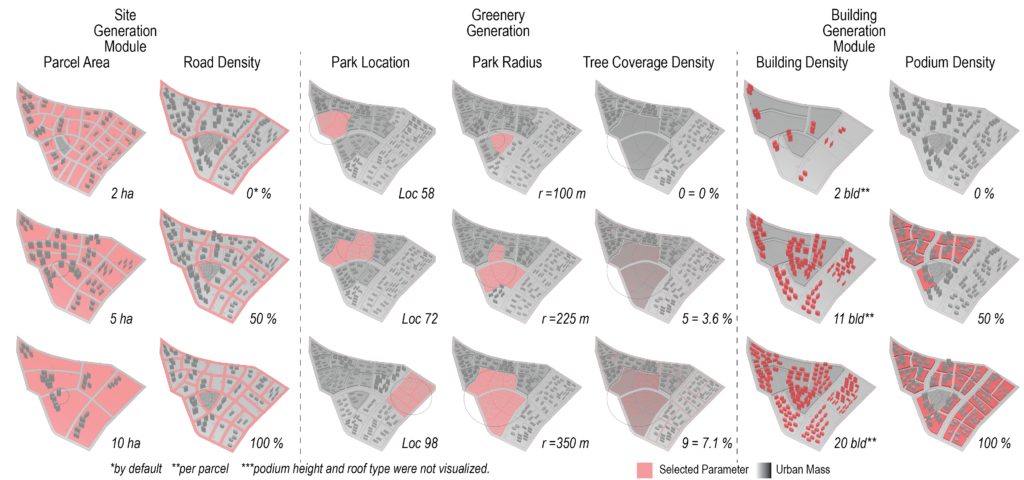
From the SA of 21,000 model solutions for a 100 ha case study site in Singapore, building density, podium density, and land parcel area are found to have the greatest impacts on UHI.
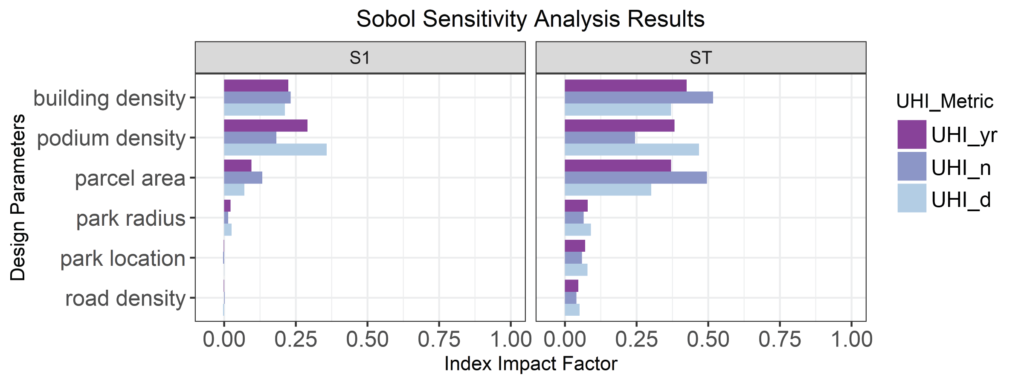
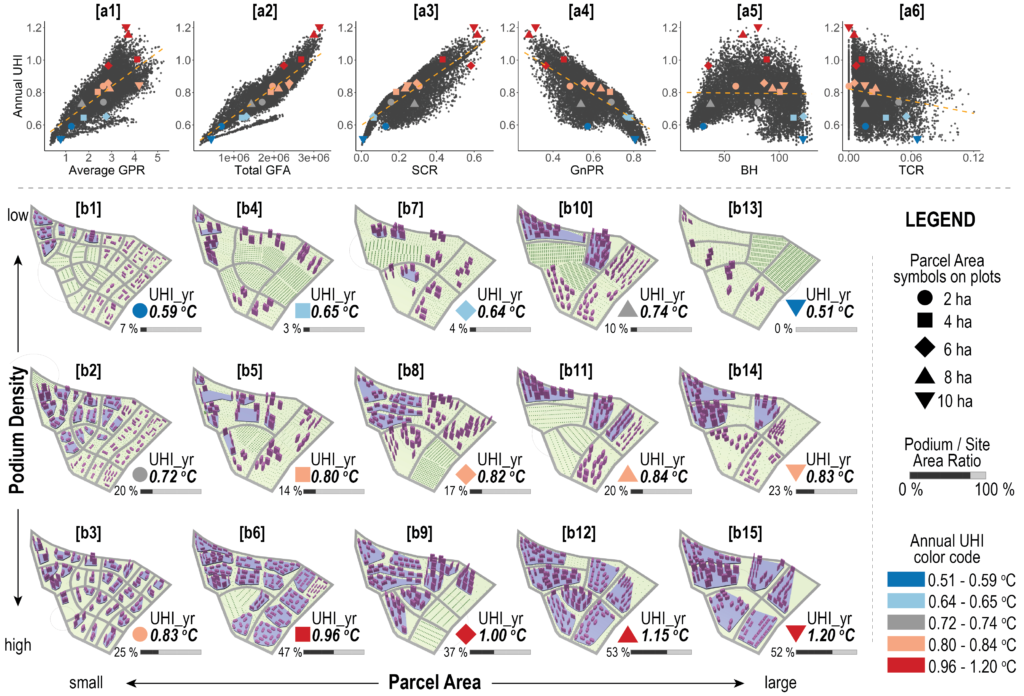
This finding supports the hypothesis that urban planning parameters have a high potential for UHI mitigation. Key findings include that a high green plot ratio (>50 %) combined with a low site coverage ratio (<50 %) permits even high-density model solutions (gross plot ratio >4) to maintain annual UHI below 0.89 °C.
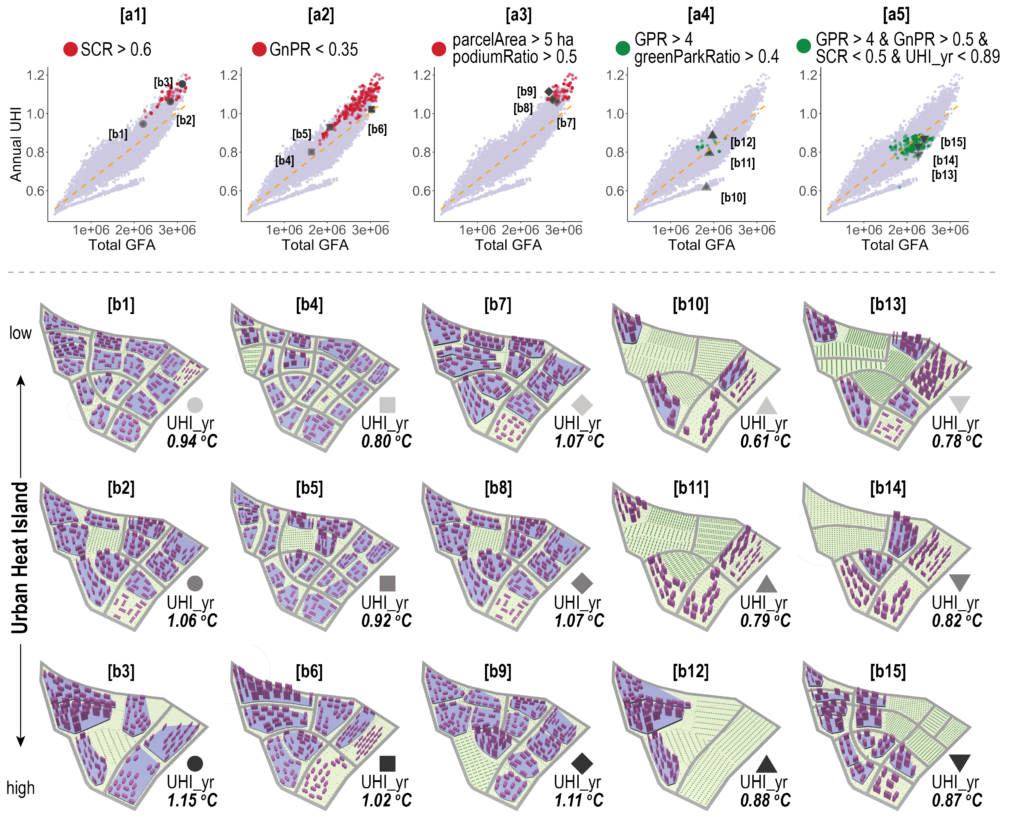
The conclusion discusses the implications of the findings for heat-resilient city planning and demonstrates that performance-based evaluation of generative urban models can improve upon prescriptive planning approaches.
Credits:
PI: F Peter Ortner / Co-PI : Peng Song
Research Fellow: Elif Esra Aydin
PhD Candidate: Tay Jing Zhi
Research Assistant: Zebin Chen, Anna Yenardi
Funding: URA Strategic Partnership Grant