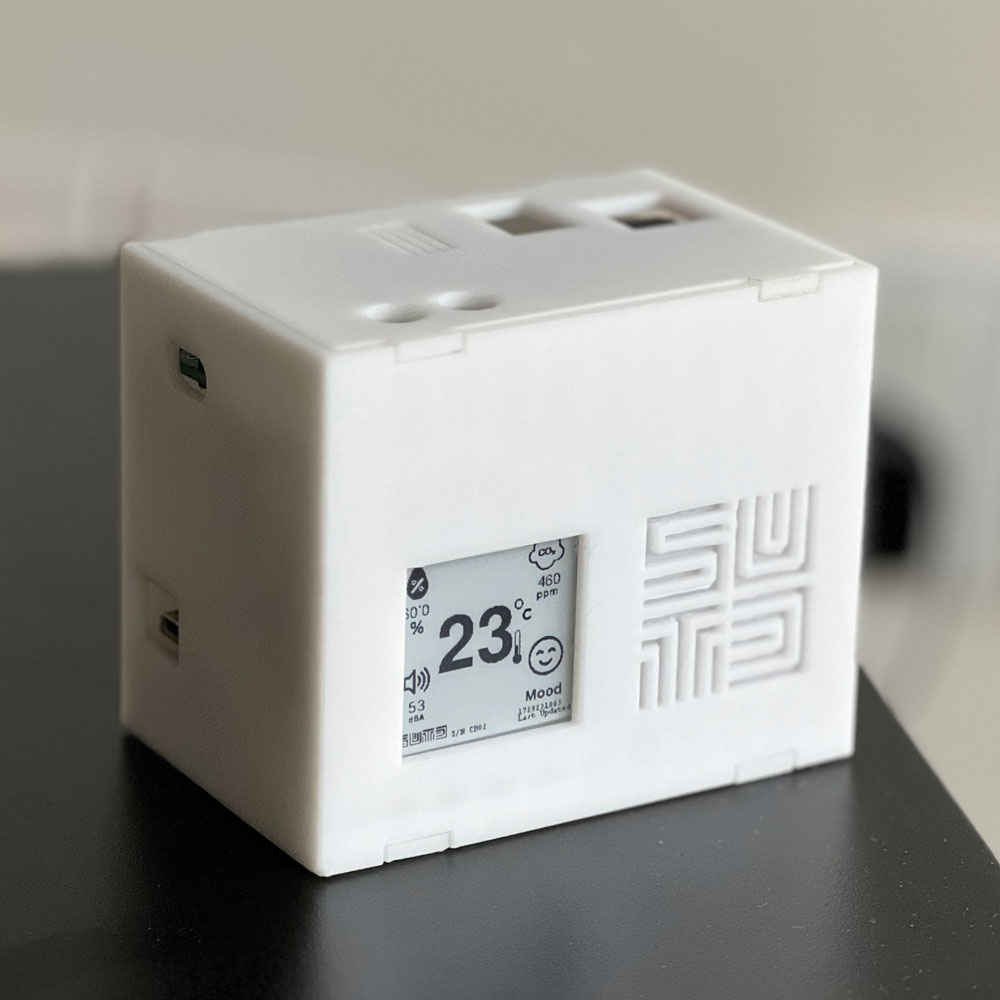
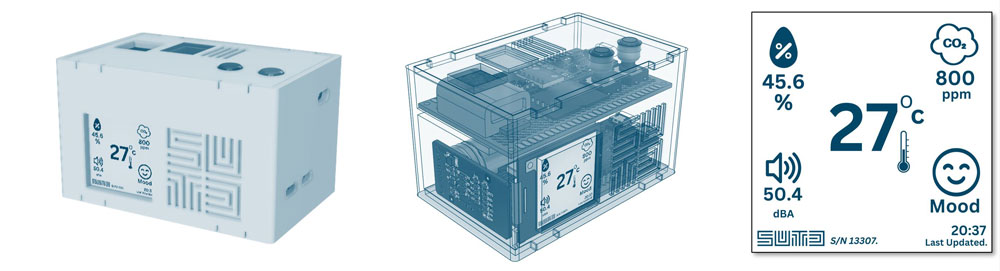
Building management systems have long been designed with facility managers in mind — centralised dashboards that aggregate sensor data for a small number of technical users. The Sustainable Social Building Assistant (SSoBA) starts from a different premise: that occupants and visitors, not just managers, are agents of building performance. SSOBA is an architectural digital twin deployed in an test bed at SUTD’s Parcel D building. It presents environmental and energy data through layered interfaces, a room-level display features communicative “avatars” and a campus-wide 3D view. These layers are designed to connect everyday users with the unseen performance of the spaces they occupy.
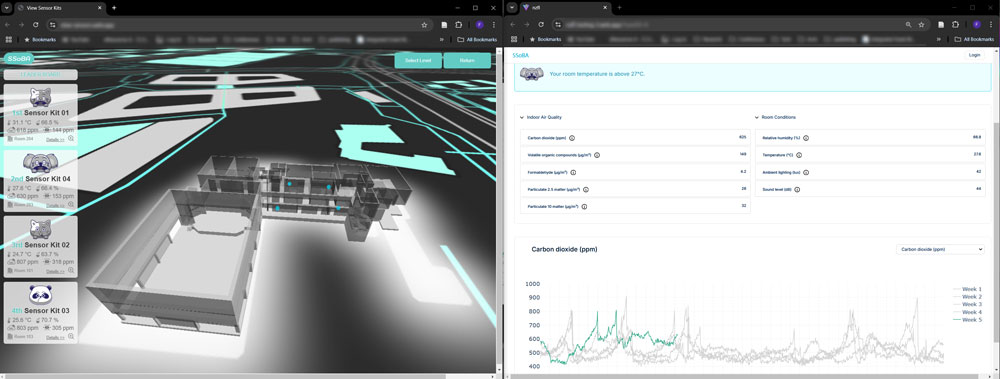
The system is grounded in behaviour change research, specifically the intention-behaviour gap identified in environmental psychology: knowing that you should act sustainably and actually doing so at the right moment are two different things. SSOBA addresses this by combining social comparison data (how peers are performing), spatial information, and timely nudges toward specific actions. Initial results from before-and-after data collection at Parcel D show energy consumption reductions of up to 30%. The project represents a deep interdisciplinary collaboration across architecture, computer science, and engineering.
Citation
Ortner, F.P., Yalcinkaya, S., Han, C., Perrault, S., Kwan, W.L., Govindarajan, P. (2025). Sustainable Social Building Assistant (SSOBA): Transforming Energy Use via Digital Twins, Environmental Sensing and Occupant Behaviour Change. CAAD Futures 2025 — Catalytic Interfaces, Vol. II, pp. 673–687. University of Hong Kong. https://doi.org/10.25442/hku.29365262
Acknowledgements
Authors: F. Peter Ortner, Kwan Wei Lek, Simon Perrault, Sezgi Yalcinkaya, Chewon Han, Praveen Govindarajan. This research was advanced as part of the the Net Zero Futures Lab (NZFL) funded by the SUTD Design Z International Design Centre (2023–2026).